Deliverable · Product family

AI companion speakers: three modules, one acoustic discipline
Stratified by screen, not by spec sheet

M08 on RK2108D for the cost and power floor — small panel, two microphones, no video. RK3506B for the 720p volume tier — four microphones, twelve light channels, 720p software video. RK3572 for on-device ASR, TTS and an avatar across two displays. Same array method, same local wake word, same backend socket. Seven shells to choose from — from a 320×480 pixel companion to a dual-display avatar unit.

InquireAll solutions
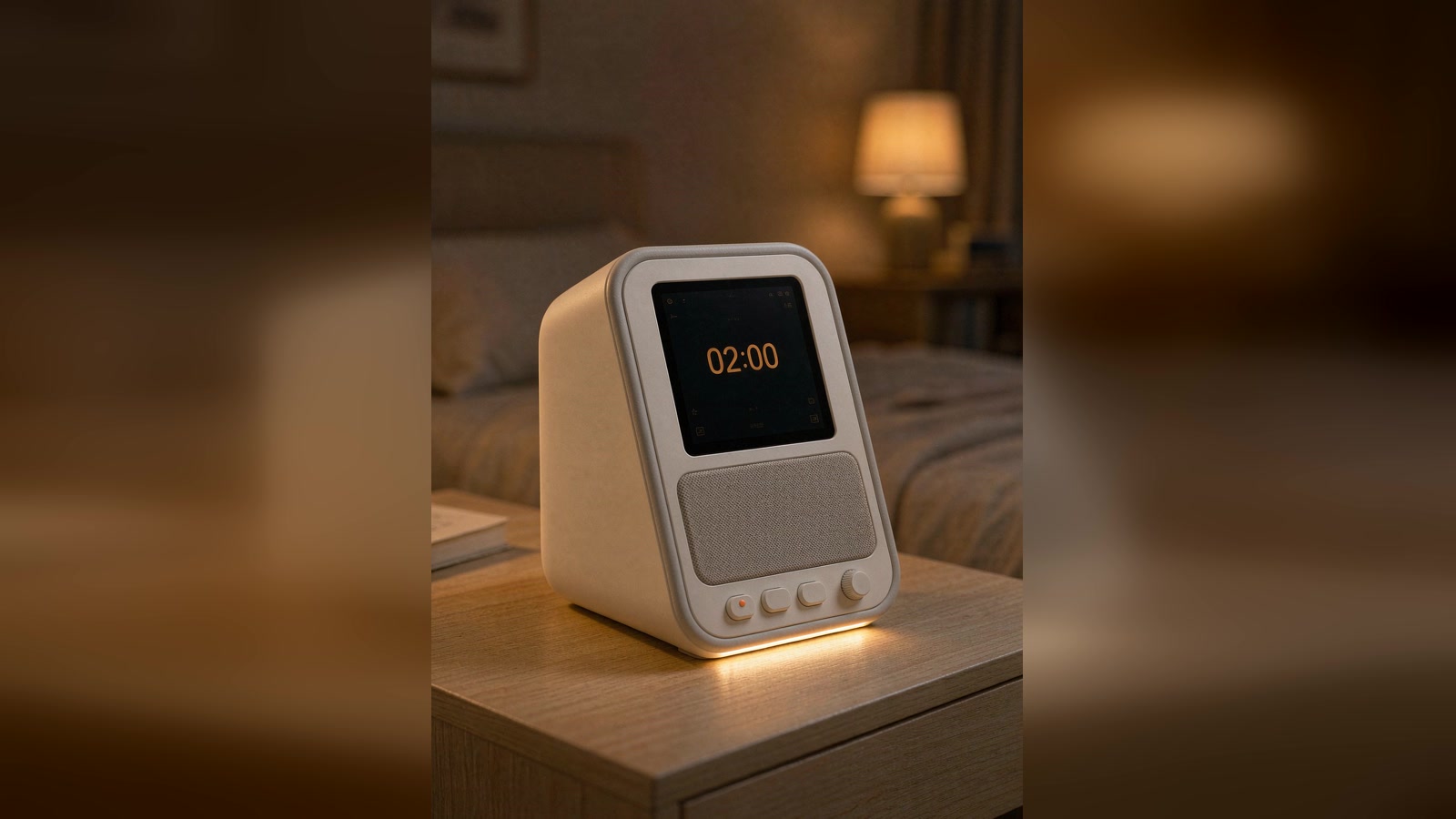
AI companion speaker reference design: fabric front, 720p display, three buttons, warm underglow light
The RK3506B tier: four PDM microphones behind the fabric, 10 W Class-D, twelve PWM light channels, 720p panel.
Why a family

The screen decides the price, and the price decides the market

One board cannot be both the cheapest credible companion and the one that runs an avatar.

A companion speaker's bill of materials is dominated by three things: the panel, the memory behind it, and the compute that drives it. Those three move together. Put a 720p panel and four microphones on a micro-controller and you have overpaid for a device that cannot fill the screen; put a 320×480 panel on an eight-core application processor and you are burning a dollar of silicon to draw a clock.

So we build the family on an axis the customer can actually feel — screen and interaction — and let the silicon follow. Three modules cover it: M08 on RK2108D for the cost and power floor, RK3506B for the 720p volume tier, RK3572 for on-device speech and an avatar. What does not change across the three is the acoustic method, the wake-word rule, or the backend contract.

SCREEN DECIDES THE TIER M08 RK2108D · RT-Thread MCU/SPI LCD up to 320x480 2 microphones · no video 4 x PWM light cost and power floor RK3506B 3 x Cortex-A7 1.5 GHz · Linux 720p panel · 2-lane MIPI 4 mics from 8-ch PDM RX 720p@30 video, software 12 x PWM light the volume tier RK3572 2x A73 + 6x A53 · Linux two displays, 4K + 2K 8-ch PDM + 6 x SAI 4 TOPS NPU + Mali-G310 ASR, TTS, avatar on device Shared across all three: the same array method, the same echo-cancellation discipline, the same wake-word-locally rule, and the same backend contract. What changes is the panel, the core count and where the intelligence lives. Screens shown are panel capability, not a product claim: each SKU's glass is chosen by your ID.

Three tiers on one axis. The middle one is the volume tier and the one we recommend starting with.

Matrix

The three tiers, side by side

Everything below is platform capability from the vendor datasheets. Nothing here is a measurement from a unit on a bench.

ItemM08 — RK2108DRK3506BRK3572
TierEntry: voice firstVolume: 720p interactionFlagship: on-device AI
CPUCortex-M4F, up to 400 MHz3 × Cortex-A7 @1.5 GHz + Cortex-M02 × Cortex-A73 @2.2 GHz + 6 × Cortex-A53 @2.1 GHz
DSP / GPUCadence Tensilica HiFi32D engine only (scale / rotate / mirror)Mali-G310V2 MC1, Vulkan 1.4
NPUNoneNone4 TOPS INT8, INT4/INT8/INT16/FP4/FP8/FP16/BF16
Memory on module1 MB SRAM + 512 KB DTCM, FSPI pSRAM16-bit DDR2/DDR3/DDR3L, up to 1 GBLPDDR4/4X/5/5X, 32-bit, up to 16 GB
DisplayMCU/SPI LCD up to 320×480; MIPI LCD also available720p class: 2-lane MIPI and RGB up to 1280×800@60Two independent displays: 4K@60 + 2K@60
Microphones2 (built-in 2-channel audio ADC; 4-channel PDM also available)4 in product, from 8-channel PDM RX4–8, from 8-channel PDM plus 6 × SAI
VideoNone720p@30 H.264 / MJPEG, software decodeHardware decode H.265/VP9/AV1/AVS2 to 8K@30, H.264 to 4K@60
Light channels4 × PWM12 × PWM16 × PWM
OSRT-ThreadLinuxLinux / Android
Where the intelligence livesCloudCloudASR, TTS and avatar on device; LLM still in cloud or ignored

The one row people misread. RK3506B has no video processing unit. Its 720p at 30 fps H.264 and MJPEG are decoded in software on the A7 cores — that is what the module vendors publish, and MYIR's own comparison table lists the VPU as a dash next to RK3506B while RK3562 gets 4K@30. It is enough for a UI animation, a looping clip or an RTSP preview. It is not enough for 1080p60 playback, and if you need that, the answer is the RK3572 tier, not a firmware trick.

Form factors

Seven shells, two display languages, three tiers

Capability is the inner axis, appearance is the outer one. They are independent — pick a shell, and the panel inside it decides which module goes behind.

The three tiers above answer how much machine. These seven shells answer what it looks like on the table. They are not three products plus four variants of one product; they are seven mechanical directions, and the constraint that binds each one is the panel.

Look at what is on the screens. Four of the seven draw in a pixel language — a dot-matrix clock, an eight-bit character, a landscape made of blocks. Three show a photograph. That is not a style choice, it is a specification. A pixel scene stays legible on a 320×480 MCU panel driven straight off the micro-controller’s SPI bus; a photograph does not. The moment a shell has to render real imagery the panel moves to MIPI, the frame buffer grows, the SoC changes, and the unit cost changes with it.

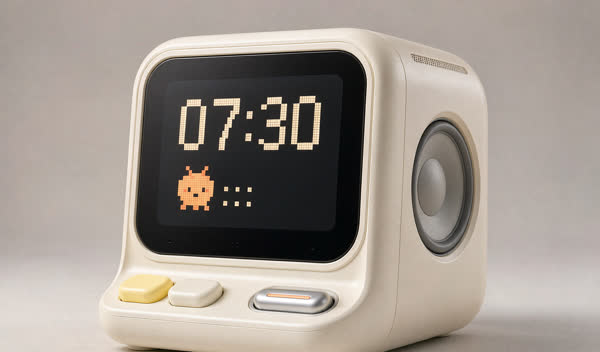
Cube form factor: an upright cream cube with a near-4:3 panel, three physical keys along the front base, a round speaker on the right flank and a vent strip on the top shoulder
Reference shell

Cube

The one we would build first. An upright cube with a near-4:3 panel set into a deep bezel, three physical keys along the front base — two soft-touch squares and a brushed bar with a warm light seam — one large round driver on the right flank, and a slim port strip on the top shoulder. Three keys is a deliberate number: wake, volume, mute, with nothing hidden behind a menu. The deep bezel is doing acoustic work as well as visual work, because the volume behind it is what the driver needs.

  • Panel480×320 class, MCU/SPI
  • TierM08 and up
  • Controls3 front keys, side driver
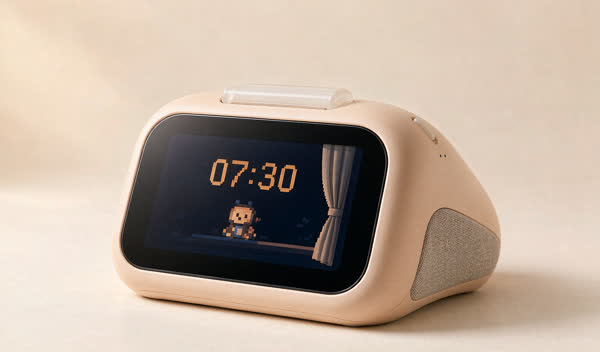
Pillow form factor: a soft cream wedge with the panel set into the rake, a translucent light bar recessed into the top edge and a triangular fabric speaker face on the side

Pillow

A wedge that reads as a cushion: low at the front, higher at the back, the panel on the rake, a translucent light bar recessed along the top edge, and the speaker behind a triangular fabric face on the side. It is the shell that reads least like a computer, which is why it is the one that survives a bedside table.

  • Panel320×480 class, MCU/SPI
  • TierM08
  • ControlsTop light bar, side fabric face, side keys
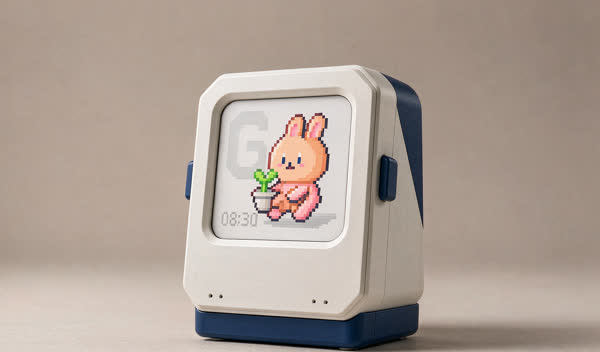
Mini TV form factor: a near-square front face in a cream and navy two-tone shell, two small side knobs and four ports along the lower front edge

Mini TV

A near-square face in a two-tone shell — cream body, navy base and side plates — with two small side knobs and four ports along the lower front edge. The proportions are borrowed from a portable television, and so is the interaction: knobs and no touchscreen, because a hand reaching in the dark wants something to turn.

  • Panel320×480 class, square
  • TierM08
  • ControlsTwo side knobs, 4 lower mic ports
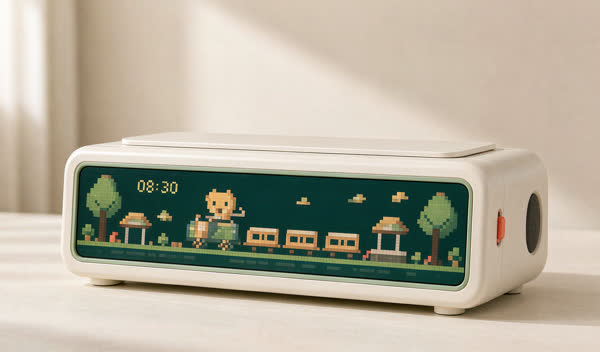
Slab form factor: a low wide white bar with a roughly 3:1 panel across the front, a slim plate on top, an orange knob at the right end

Slab

A low, wide bar laid horizontally, a panel at roughly 3:1 across the front, a slim plate resting on top, an orange knob and a round port at the right end, four small feet. The width is the entire argument: a 3:1 canvas is where a landscape scene, a progress story or a row of cards actually works — and it is the first shell on this page that a 320×480 panel cannot serve.

  • PanelMIPI, 1280 wide and up
  • TierRK3506B
  • ControlsEnd knob, top plate
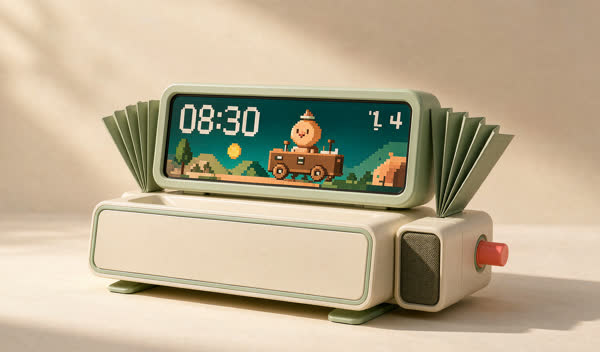
Retro radio form factor: a long cream and sage enclosure with a plain front panel, a floating display on a sage bracket, fan-fold wings either side, a square grille and a red knob at the right end

Radio

A long enclosure with a plain front panel, a display floating above it on a sage-trimmed bracket, fan-fold wings either side of that display, a square grille and a red knob at the right end. The empty front panel is the honest part: it is volume for the low end, and at this size the driver behind it is what makes a 10 W amplifier worth fitting.

  • Panel720p class, MIPI
  • TierRK3506B
  • ControlsEnd knob, square grille
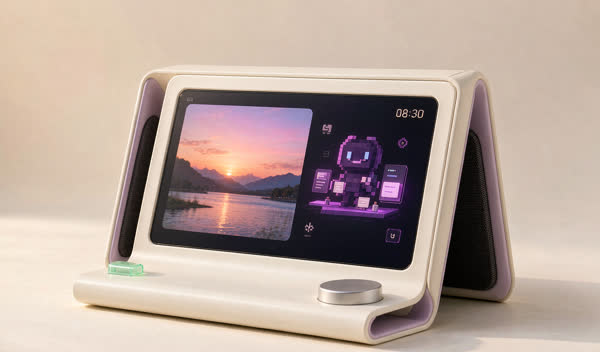
Tent form factor: an A-frame standing on a front tray, fabric-covered side slopes, a cylindrical metal knob on the tray, and a split screen with a photograph on one side and the companion interface on the other

Tent

An A-frame standing on its front tray: a panel facing forward, fabric-covered slopes either side, a cylindrical metal knob on the tray, and a split screen — a photograph on the left half, the companion’s interface on the right. Two things happen at once here and that is the design: the room on one side, the character on the other.

  • Panel720p class, MIPI
  • TierRK3506B
  • ControlsFront tray knob, fabric slopes
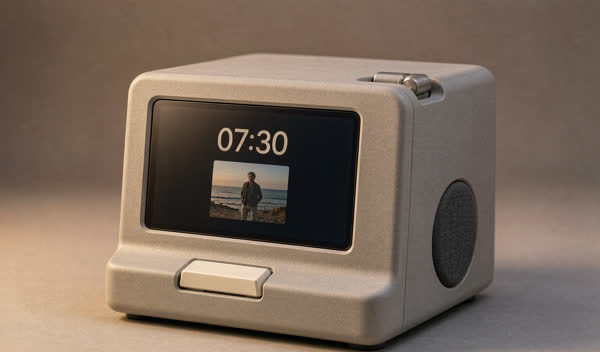
Studio form factor: a grey fine-grained cube with a wide panel showing a single framed photograph, a large soft key on the front base and a knurled metal knob on the top-right shoulder

Studio

A grey, fine-grained cube with a wide panel that plays a single photograph as a framed print, a large soft key on the front base, a knurled metal knob cut into the top-right shoulder, one round fabric driver on the side. This is the shell for the buyer who would not put a toy on a desk — and the photograph is the requirement, not the decoration.

  • Panel720p class, wide gamut
  • TierRK3506B, or RK3572
  • ControlsShoulder knob, front soft key
ShellDisplay languagePanel classModuleInteraction hardware
CubePixel clock + character480×320 class, MCU/SPIM08 → RK3506B3 front keys, side driver, top port strip
PillowPixel + bedroom scene320×480 class, MCU/SPIM08Top light bar, side fabric face
Mini TVSingle pixel character320×480 class, squareM08Two side knobs, four mic ports
SlabWide pixel landscapeMIPI, 1280+ wideRK3506BEnd knob, top plate
RadioPixel landscape720p class, MIPIRK3506BEnd knob, square grille, 10 W
TentPhoto + companion UI, split720p class, MIPIRK3506BFront tray knob, fabric slopes
StudioReal photograph, framed720p class, MIPI, wide gamutRK3506B / RK3572Shoulder knob, front soft key

What these images are, and are not. They are form-factor directions, not tooling. Internal layout, port positions and light diffusion in each one are design intent read off the renders — every one still has to pass an acoustic and mechanical review before a mould is cut, and on more than one of these the driver will move. What is fixed is the mapping: display language decides the panel, the panel decides the module, and none of the seven changes the array method, the local wake word or the backend socket.

Pick a shell, and we will tell you what it costs. Name the one that looks like your product and what has to appear on the screen; between those two answers there is only one module choice left. We will say it plainly — including when the answer is “that shell wants an RK3572”. → Contact us

Tier 1

M08: what the floor looks like

A micro-controller, a small panel, two microphones and a DSP that costs almost nothing to leave on.

RK2108D pairs a Cortex-M4F with a Cadence HiFi3 DSP and puts 1 MB of SRAM and 512 KB of DTCM on the die. There is no operating system underneath the application beyond RT-Thread, no application processor to boot, and no video pipeline to power. A 320×480 MCU/SPI panel is the natural fit; a MIPI panel is available on the D variant if the ID demands it.

Two microphones is not a compromise here, it is the specification. With a small speaker at low volume and a fixed geometry, a two-element array plus a converged echo canceller is sufficient for near-field conversation at arm's length, and the HiFi3 DSP is built for exactly that — the vendor's own framing is voice noise reduction with 4 × 24-bit MAC or dual 32-bit MAC, three VLIW slots and a two-way SIMD vector FPU.

What M08 cannot do should be said before the first meeting: no video, no local language model, no large display. Where it wins is idle power and unit cost — the two numbers that decide whether a companion device can be sold at a price a retailer will take.

Tier 2

RK3506B: the sweet spot, and why it is the one to start with

This is the tier in the photograph. Three Cortex-A7 cores at 1.5 GHz running Linux, eight channels of PDM capture in silicon, twelve PWM channels for the light, a 2-lane MIPI output for a 720p panel, and a 2-channel audio DSM plus ASRC for mixing a local prompt into a streamed reply. No NPU, and for this product that is the correct omission: everything expensive and everything interesting is in the cloud, and the device's job is to hear, speak, light a room and not crash.

Four microphones from an eight-channel interface is deliberate headroom. It leaves the option of adding elements to the second SKU without a new board, and it means the array can be specified by acoustics rather than by pin count. The 720p panel is the other reason this is the volume tier: at arm's length on a nightstand, 720p is resolving enough for a clock, album art and an animation, and it costs a fraction of the 4K-capable path.

8PDM RX channels in silicon
4microphones in product
12PWM light channels
720ppanel, software video
Tier 3

RK3572: when the device has to work with the network down

4 TOPS, a Mali-G310, two screens — and the honest boundary of what fits.

RK3572 is an eight-core part on 8 nm: two Cortex-A73 at 2.2 GHz and six Cortex-A53 at 2.1 GHz, a Mali-G310V2 GPU with Vulkan 1.4, a 4 TOPS INT8 NPU, LPDDR5 up to 16 GB and two independent display pipes at 4K@60 plus 2K@60. Two things follow that the other tiers cannot do.

The first is two screens: a face on one panel and a list, a recipe or a room control on the other, driven independently rather than mirrored. The second is speech on the device: small ASR and TTS models on the NPU, and an avatar that is a GPU job — face rendering, expression and lip-sync — with the NPU feeding it. Wake word, recognition and synthesis can then run with no network at all, which changes the product's failure mode from "useless offline" to "less clever offline".

The limit, stated as a number. 4 TOPS is a small-model budget. Published figures for this class of part put a 0.6B model at roughly 190 ms to first token and 23 tokens/s, and a 1.7B model at roughly 360 ms and 9 tokens/s. That is fine for command understanding and short answers. It is not a chat product. For a real conversation model the device still talks to a backend — which is exactly the architecture all three tiers share.

Shared discipline

What is identical across the three

The method does not get cheaper at the low end. The tuning does get redone every time.

Wake word stays local

On all three tiers the wake word is detected on the device, so audio before it never leaves the product. It is a latency decision and a privacy decision, and it is not negotiable per SKU.

Echo cancellation is mechanical

Speaker, port and microphone plane are fixed together in the enclosure design. A converged AEC on a dev board tells you nothing about a product whose speaker is eight centimetres from the array.

The light is an interface

Below the sleep threshold, brightness and colour temperature capped independently of the audio path: listening, thinking, muted, alarm. Four PWM channels are enough to do it badly; twelve make it easy to do it well.

One backend contract

Device identity, session, up and down audio, OTA with rollback, telemetry, and a written list of what leaves the device. Identical across M08, RK3506B and RK3572, so a second SKU is a port and not a project.

Muse Gadget SDK

It runs on tiers two and three — and here is the clause to read first

Meta open-sourced the Muse Gadget SDK in October 2026 under Apache 2.0, in two halves: an ESP32 device SDK on ESP-IDF, and a Linux device SDK for Raspberry Pi-class boards. The Linux half maps onto RK3506B and RK3572 directly: persistent connection, Opus audio, a small display, GPIO, reconnect with backoff. On M08 the same protocol would have to be reimplemented on RT-Thread over the micro-controller's own stack — a real piece of work, not a build flag.

What we will not tell you: Meta's current terms state that the SDK and its tokens are not a supported product, that access can change or be withdrawn at any time, and that tokens are for personal, non-commercial use. A companion speaker you intend to manufacture and sell is commercial use. No SDK licence grants that, and we cannot grant it either. If your plan is "ship on Muse", the prerequisite is a business agreement with Meta — not an engineering task, and not something we can shortcut.

Which is why the backend is a socket in the design, not a foundation. Your cloud, ours, or Meta's — the firmware changes one module.

BackendWho owns the account and dataWhat we deliverFits
Your backendYou. The device is a terminal to your service.Firmware against your API contract, plus a reference backend during development so bring-up is not blocked on yours.You already run an assistant, an app or a data platform.
METO-hostedYou own configuration and content; we operate the service.ASR, LLM, TTS, device auth, OTA, content management, usage reporting.You want the product in market before the platform team.
Muse Gadget cloudMeta. The user's Muse account.Board port, token provisioning, and the honest account above.Prototype, internal tool, or a commercial launch after an agreement exists.
ODM

What you receive

Six work packages, identical in shape across the three tiers. The fourth decides whether the second batch survives.

1. Module and baseboard

SoM plus a carrier sized to your enclosure: power tree, amplifier and peak headroom, light driver, panel interface, microphone placement and acoustic porting.

2. Acoustic design

Array geometry simulated against your ID, speaker and port placement, enclosure resonance, AEC tuning on the real mechanical sample.

3. Firmware and on-device audio

BSP or RT-Thread bring-up, capture and playback, AEC / beamforming / NS, local wake word, Opus, light state machine, panel UI, OTA with rollback, low-power idle.

4. Backend integration

One of the three models, implemented against a written contract, with a reference implementation during bring-up. This is the package that gets skipped when schedules slip, and the one that comes back as a field problem.

5. Pilot and volume

EVT / DVT / PVT, certification support (CE, FCC), production test fixtures including an acoustic pass/fail a line operator can run.

6. Second SKU

Moving up or down a tier reuses the backend contract, the test fixture and the light language. New board, new acoustic tuning, no new platform.

Specification

Platform numbers, per tier

Datasheet capability. No bench measurements are claimed anywhere on this page.

ItemM08 / RK2108DRK3506BRK3572
Process28 nm class, ultra-low power22 nm8 nm
CPUCortex-M4F up to 400 MHz, 16 KB I/D cache3 × A7 @1.5 GHz, 128 KB L2, + Cortex-M02 × A73 @2.2 GHz + 6 × A53 @2.1 GHz
Audio in2-channel audio ADC; 4-channel PDM; I2S 2 TX + 4/6 RXPDM RX 8 ch; SAI 1/1 ×2, 1/4 ×1, 4/1 ×1; ADC 1 chPDM 8 ch; 6 × SAI to 192 kHz; 3 × SPDIF TX, 2 × RX
Audio outI2S, multi-format codecSAI TX, SPDIF TX, DSM 2 ch, ASRC 4 ch ×2SAI, SPDIF, 2-channel DAC, ASRC 4 ch
DisplayMCU/SPI LCD to 320×480; MIPI LCD (D)2-lane MIPI / RGB to 1280×800@60VP0 4K@60 + VP1 2048×1080@60; HDMI 2.1, eDP, MIPI DSI, RGB, EBC
Video decode—720p@30 H.264 / MJPEG, softwareHardware: H.265/VP9/AV1/AVS2 to 8K@30, H.264 to 4K@60
NPU——4 TOPS INT8
PWM41216
StorageFSPI NOR, pSRAMeMMC 4.51, SD 3.0, QSPI NOR/NANDeMMC 5.1, UFS 2.0, SD 3.0, FSPI
OSRT-ThreadLinuxLinux / Android
Process

Five steps, whichever tier you pick

StepWhat happensWhat we need from you
1. Pick the tier by screenPanel size decides the SoC. Start at RK3506B unless you know the price ceiling or the offline requirement already.Retail price target, room, and whether it must work offline.
2. ID and acoustics togetherArray geometry, speaker and port placement, light diffuser, panel — simulated against the real enclosure.ID direction or an existing housing, and the mechanical envelope.
3. Bring-upBSP or RT-Thread, capture and playback, AEC tuning on the sample, wake word, Opus, transport, backend contract.A backend endpoint, or permission for us to stand one up.
4. OTA and provisioningDevice identity, first-boot provisioning, signed firmware, rollback, fleet telemetry.Your identity scheme, or a decision to let us define one.
5. Pilot then volumeEVT/DVT/PVT, certification, production test with an acoustic pass/fail on the line.A pilot quantity and a real user group; the second batch is decided by the first.

Step two cannot be compressed by buying a better microphone. Echo cancellation quality is decided by mechanical integration and by how long you are willing to measure the actual enclosure.

Related

Where this fits

—

Basis of figures

M08 / RK2108D [chip]: Rockchip RK2108 product page and RK2108D datasheet V1.1 — Cortex-M4F up to 400 MHz, Cadence Tensilica HiFi3 DSP with 4 × 24-bit MAC or dual 32-bit MAC, three VLIW slots and a two-way SIMD vector FPU, 1 MB shared SRAM plus 512 KB DTCM, built-in 2-channel audio ADC, PDM and I2S interfaces, MCU/SPI LCD and MIPI LCD on the D variant, 4 × PWM, RT-Thread, no video decoder. RK3506B [chip]: Rockchip RK3506 product page and RK3506B datasheet V1.1 / V1.4 — triple-core Cortex-A7 at up to 1.5 GHz plus Cortex-M0, 128 KB L2, PDM RX 8 channels, SAI ports as listed, audio ADC 1 channel, audio DSM 2 channels, ASRC 4 channels × 2, PWM × 12, 16-bit DDR2/DDR3/DDR3L, 2D engine at 1280×800@60 with RGB / MCU / 2-lane MIPI output, WBBGA333L 13.3 × 11.3 mm at 0.562 mm pitch, no NPU. 720p@30 H.264/MJPEG software decode and the absence of a VPU are as published in module vendor specifications (Firefly ROC-RK3506B, MYIR MYC-YR3506, Wanxiang Aoke RK3506), where the VPU row is a dash. RK3572 [chip]: Rockchip launch material dated 2026-05-08 and the RK3572 datasheet V1.1 summary — 8 nm, 2 × Cortex-A73 @2.2 GHz + 6 × Cortex-A53 @2.1 GHz, Mali-G310V2 MC1 with Vulkan 1.4, 4 TOPS INT8 NPU, LPDDR4/4X/5/5X to 16 GB, hardware decode of H.265/VP9/AV1/AVS2 to 8K@30 or 4K@120 and H.264 to 4K@60, dual display 4K@60 + 2048×1080@60, 8-channel PDM with 6 × SAI, 16 × PWM, FCCSP550L. Model latency figures quoted in the RK3572 section [vendor benchmark]: 0.6B class at about 190 ms TTFT and 23 tokens/s, 1.7B class at about 360 ms and 9 tokens/s, measured by the vendor on a reference tablet — quoted to size the tier, not as a product guarantee. Array figures [physics]: c = 343 m/s, usable band from c/D to c/2d with D = (N−1)d. Nothing on this page is a measurement from our own unit, and no acoustic performance figure is claimed.

Next step. Tell us the retail price target, the room, the distance and whether it must work offline. We will tell you which tier, and where the money actually goes. → Contact us
↑