Product release

The box is a shell. What you are choosing is which card goes inside.

A small brain for production lines, homes, machines, robots and camera clusters. One RK1828 card holds a 3B model, two hold 9B, four hold 27B — same chassis, same firmware, same tooling. Model capacity becomes a card count instead of a purchase decision.

2026-10-30·Product release·Shenzhen
InquireAll news
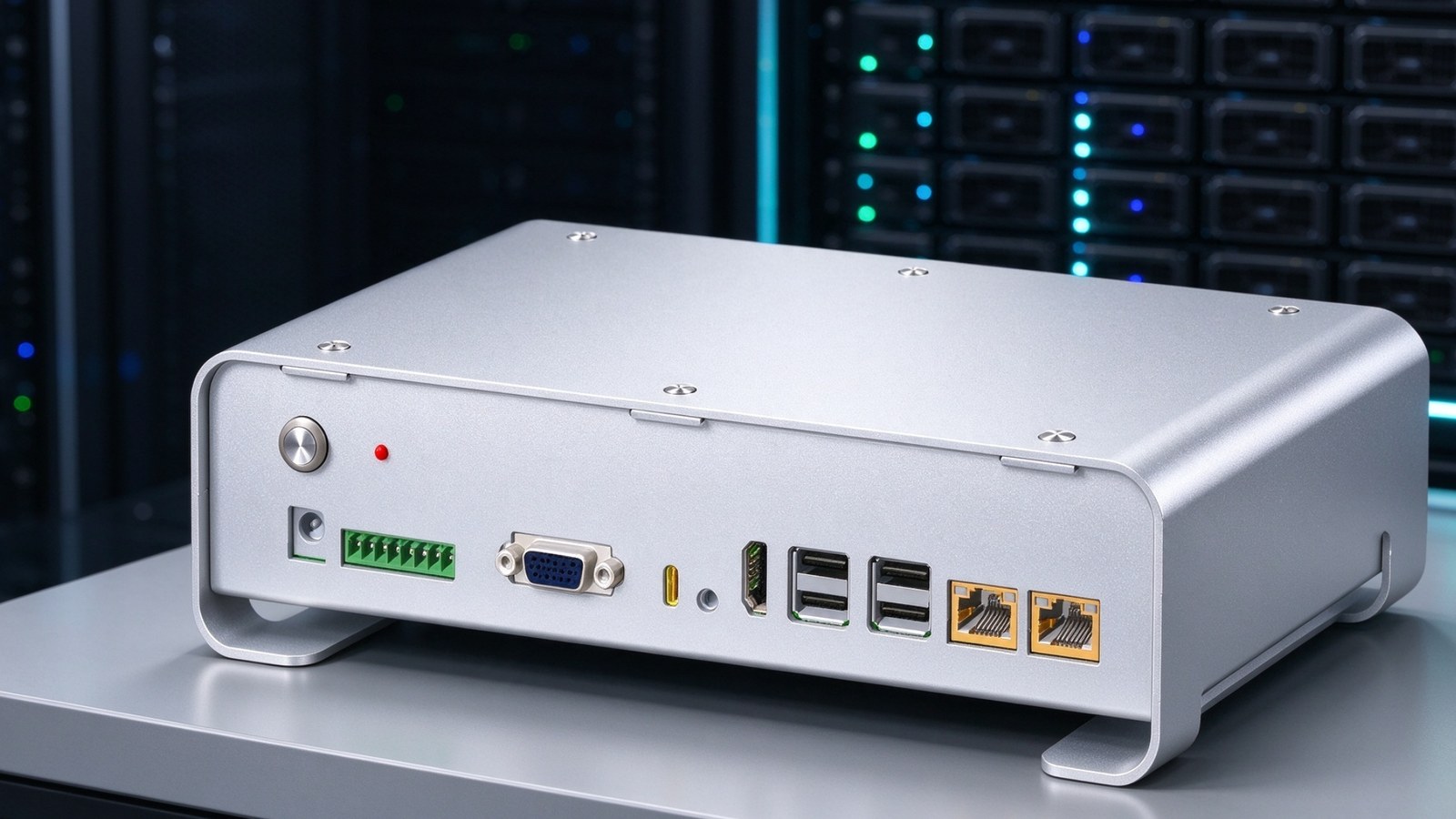
Aluminium edge AI box photographed at a three-quarter angle, front panel showing power button, terminal block, serial port, HDMI, USB ports and two shielded Ethernet ports, with an SMA antenna on top
The RK3576 build. Everything that plugs in comes out of one face, so the box can sit against a panel.
Overview

An edge box, not a server that got small

There is a class of place where a model needs to run and a server cannot go: a production line that already has power but no rack, a house with a router and no ventilation, a machine enclosure with 40 mm of clearance and nobody on site to reboot anything. These are the places this box is built for, and the job it does there has a plain name in factory language — the small brain, the thing that decides locally instead of asking the cloud.

The design decision worth arguing about is not the enclosure. It is that the model capacity lives on a replaceable card rather than on the main processor. One RK1828 card holds a 3B-class model. Two hold 9B. Four hold 27B. Same chassis, same firmware, same deployment tooling — what changes is how many cards are in it. A customer who starts with a 3B inspection model and later needs a 27B model for line-wide reasoning does not buy a second box.

3Bone RK1828 card
9Btwo cards
27Bfour cards
2.4–2.6 %host CPU while inferring

Two hosts are offered. RK3576 carries a single card and covers the floor-side job: inspection, work instruction, a local voice assistant. RK3588 carries one or four, and the four-card build is the one that holds a 27B model resident.

Where it goes

One box, four jobs, two of which are called a brain

The same hardware turns up in four different places under three different names, and the naming is not marketing — it describes whether the box is the only computer on the device or the one that sits behind a bigger one.

RoleWhere it sitsWhat decides it
Small brain — edge gatewayProduction line, home, machine cabinetIt decides on site, so the frames never leave the plant and the answer does not wait for a round trip
Small brain — sensor fusion and video analyticsWherever several cameras convergeRK1828 carries the model; KA08 carries dense decode and classical CV, up to 32 streams of 1080p
Brain — robot and robot dogInside the bodyA four-card 27B build averages 57.8 W. That is the figure to check against the platform's power and thermal budget, and it is the whole reason this is not a rack product
Per-scenario compute nodeOne small on-site server per line or per roomTwo cards at 30.5 W average, four at 57.8 W — an ordinary cabinet can hold it without being rebuilt as a server room

The word “brain” is doing real work in that table. On a robot dog this box is the only thing thinking, so it is the brain. On a production line there is already a PLC, a MES and a person in charge, so the box is the small brain — it handles what needs a model, and it does not try to run the line. Getting that boundary wrong is how edge AI projects end up fighting the control system instead of helping it.

The ladder

What fits, and how fast it comes out

Model capacity is set by something less glamorous than TOPS: how much weight memory sits on the card. RK1828 carries 5 GB of 3D-stacked DRAM on the package, and RK1820 carries 2.5 GB. That figure, not the 20 TOPS figure next to it, decides whether a model runs at a steady state or streams its weights across the bus on every token.

ConfigurationModel classHow it is splitBasis
1 × RK18283B — LLM, VLM or a sparse MoEWhole model on one cardProduct definition
2 × RK18289B — e.g. Qwen3.5-9B32 decoder layers cut into 2 segments: layers 0–18 on card 0, layers 19–31 plus final norm and LM head on card 1Rockchip cascade scheme, 2026.08
4 × RK182827B — e.g. Qwen3.8-27BFour sequential segments, hidden states passed card to cardRockchip cascade scheme, 2026.08

The split is by decoder layer, not by tensor, which is why it scales to four cards without a rewrite. The host tokenises, schedules the segments, and samples; each card runs its own segment and hands hidden states to the next.

Rockchip publishes measured numbers for the two multi-card builds. These are whole-system figures on an RK3588 host with RK1828 SO-DIMM modules and W4A16 quantisation, 4K or 8K input, 128 output tokens:

ModelCardsInputLinkTTFTPrefill TPSDecode TPS
Qwen3.5-9B24KPCIe4.80 s853.733.19
Qwen3.5-9B24KUSB 3.04.90 s836.033.52
Qwen3.5-9B28KPCIe9.73 s841.732.33
Qwen3.5-9B28KUSB 3.09.94 s824.032.65
Qwen3.8-27B44KPCIe6.92 s592.113.02
Qwen3.8-27B44KUSB 3.07.15 s573.213.02
Qwen3.8-27B48KPCIe13.67 s599.412.74
Qwen3.8-27B48KUSB 3.014.08 s581.712.83

Read the two blocks separately and they say different things. 9B on two cards decodes at 33 tokens a second — faster than a person reads, and enough for a voice assistant that has to answer while someone waits. 27B on four cards decodes at 13 — not a conversation pace, but comfortably faster than reading a report, which is the right target for line-level reasoning and document work. Doubling the model cost about 2.5× the decode time; that is the trade, stated plainly.

Input length is the other axis. Going from 4K to 8K input roughly doubles TTFT and barely moves decode, because prefill is proportional to prompt length while decode is proportional to nothing but the model. If your prompts are long documents, budget the wait at the front; if they are short questions, input length barely matters.

Architecture

Two processors, one narrow link

A single SoC running both the media pipeline and a language model loses on both, and it loses in a way that is hard to schedule around: the model competes for the same LPDDR that the decoder, the ISPs and the display pipes are using. Latency stops being a number you can design to.

Field devicescamerassensorsPLC · machineSouthboundinference on siteEdge AI boxHost SoC · RK3576 / RK3588capture · decode · fieldbus · business logic8K30 / 8K60 decode · 6 TOPS NPUPCIe 2.0 ×1 or USB 3.0 — weights stay resident, only prompt and tokens crossAccelerator · RK1828 ×1 / 2 / 45 GB stacked DRAM per card · weights resident20 TOPS INT8 per card · 3B → 27BData loopcollectlabelretrainNorthbounddata for trainingHost CPU stays at 2.4–2.6 % while a 9B or 27B model runs.Measured by Rockchip, 2026.08 · RK3588 host · W4A16

The link between the two is deliberately narrow: PCIe 2.0 ×1, or USB 3.0. That is enough only because the weights never cross it. They load once and stay resident in the card's own stacked DRAM; what crosses is a prompt and a stream of tokens.

The consequence is measurable, and it is the number that makes the whole architecture worth its BOM cost. While a 9B model runs on two cards, host CPU sits at 2.4 % — measured against four A76 cores at full load — and host memory averages 179 MB, peaking at 310 MB. On the 27B build it is 2.6 % and 191 MB, peaking at 524 MB.

BuildCardsLinkHost CPUHost RAM avgHost RAM peakSystem power avgSystem power peak
Qwen3.5-9B2PCIe2.4 %179 MB310 MB30.5 W67 W
Qwen3.5-9B2USB 3.02.0 %181 MB312 MB——
Qwen3.8-27B4PCIe2.6 %191 MB524 MB57.8 W119 W
Qwen3.8-27B4USB 3.02.2 %187 MB523 MB——

Power figures are whole-system validation values that include the RK3588 host, four SO-DIMM modules and the card cooling fans. A four-card 27B build drawing 57.8 W average and 119 W peak is the number that decides whether the box can live in a cabinet without an air conditioner — and it is roughly the power of a small office PC, not of a GPU server.

This is what “small brain” means in engineering terms. The host keeps doing the job it was already doing — grabbing frames, decoding video, running the fieldbus, executing the control logic — and does not slow down because a model arrived. Whatever else is on that box, it is not competing with the model.

Southbound

The side that faces the machines

Two workloads matter on a production line, and they pull in opposite directions.

Quality inspection wants determinism. A detection model looking at a moving part has a deadline measured in tens of milliseconds, and a missed deadline is a scrapped part or a stopped line. It does not want to be behind a language model in a queue.

Work instruction wants breadth. Showing an operator what the next step is, answering “why is this one rejected”, reading a drawing and pointing at the dimension that matters — that is a vision-language job, and it tolerates a second of latency in exchange for being able to explain itself.

Putting both on one card means they take turns, and the inspection deadline is the one that breaks. Putting them on separate cards fixes it by construction: card 0 runs detection, cards 1–3 hold the language model. This is the practical argument for buying more cards than the model strictly needs, and it is the configuration we recommend when a line is already running and cannot afford a stutter.

On a single-card box the same split still works, but it works by scheduling rather than by isolation, and we will say so when we quote one.

Northbound

The side that faces the data

An edge box that only runs inference is a cost. An edge box that also brings the plant's evidence back is an investment, and the difference is one direction of traffic.

The box sees the frames the line actually produces — including the ones the model gets wrong. Those are the only frames worth labelling. A closed loop looks like this: the box scores its own output, keeps the low-confidence cases and the ones an operator overrode, ships those up with their context, they get labelled, the model is retrained and re-quantised, and the new weights come back to the same cards. Nothing about the hardware changes; only the files on the card do.

We are careful about how this is sold. The loop is a service we deliver — collection policy, labelling, training and the deployment back to the device — not an automatic property of the box. Hardware that claims to train by itself is usually a box with a script that uploads images.

What the hardware does contribute is the reason the loop is cheap: because capacity lives on a card, “re-deploy the model” is a file swap on a card, and “the new model needs more memory” is a card count change, not a new enclosure.

Attaching a card

Three ways in, and why the choice matters

Every card needs one PCIe 2.0 lane or one USB 3.0 port. How those are provided is the difference between a two-card box and a four-card box.

PCIe direct

Each card gets its own PCIe 2.0 ×1 lane. Simplest and fastest, and the option to pick when the host has the lanes to spare.

PCIe switch

One upstream link — PCIe 2.0 ×1 or PCIe 3.0 ×4 — fans out to four cards. Saves host lanes, which is what makes four cards possible on a host that could not otherwise carry them.

USB 3.0 hub

Four cards share one USB 3.0 hub. The fastest route to a working four-card prototype, and the one to keep when the host's PCIe is already committed to cameras or storage.

Measured difference between PCIe and USB 3.0 on the same model and card count: about 2–3 % on TTFT and prefill, essentially nothing on decode. That is the honest size of the gap — large enough to specify PCIe on a latency-critical line, small enough that it should not stop anyone prototyping on USB.

On the host side, the reason RK3588 is the four-card platform is one line in its datasheet: PCIe 3.0 ×4 with bifurcation into 1×4, 2×2 or 4×1, plus three further PCIe 2.1 ×1 lanes on shared combo PHYs. Four single-lane cards is a supported configuration of that one controller, not a trick. RK3576 offers two combo USB 3.0 / PCIe 2.1 / SATA3 ports, which is why its build is the single-card one.

The alternative card

KA08 — when the code is already CUDA

RK1828 is the right card when the workload is a large model and the software stack is Rockchip's RKNN toolchain. It is the wrong card when a customer arrives with a working CUDA codebase and a video-analytics pipeline that took three years to tune. Rewriting that onto a different toolchain is a project, and projects have a way of not finishing.

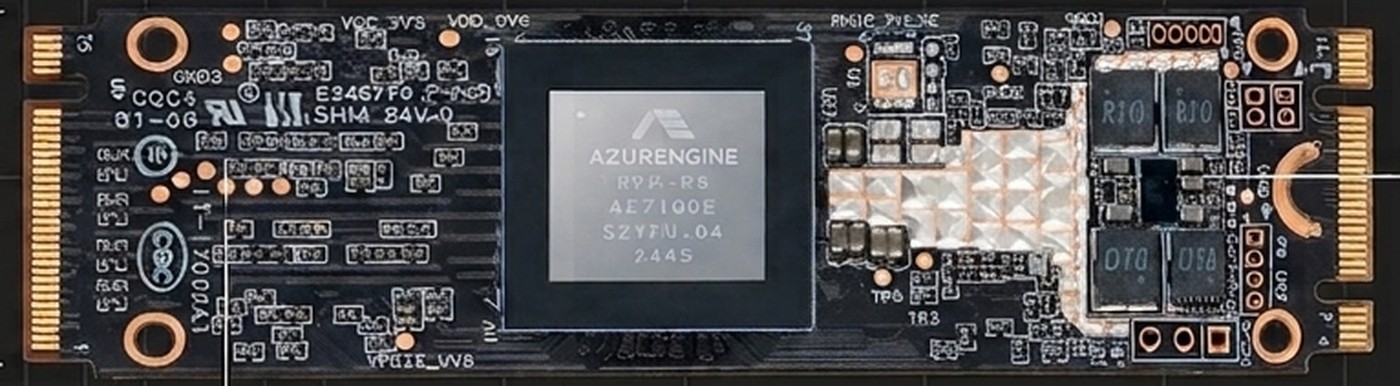
For that customer the RK3588 box accepts a KA08 general-purpose GPU card instead. It carries the XDL RPP-R8 processor: 32 TOPS INT8, 16 TFLOPS BF16/FP16, 1024 ALUs and 8092 MAC16 units, 24 MB of on-chip shared memory at roughly 1 TB/s, four LPDDR4/LPDDR4X banks of 32 bits each giving about 59.7 GB/s, and a PCIe Gen3 ×4 host interface on an 80 × 22 mm module.

KA08 general-purpose GPU card: an 80 by 22 millimetre M.2 module with the RPP-R8 processor in the centre, surrounded by LPDDR4 packages and a PCIe Gen3 x4 edge connector
KA08, 80 × 22 mm, PCIe Gen3 ×4. The RPP-R8 die sits in the middle with four LPDDR4/LPDDR4X banks alongside it and 24 MB of shared memory on the package.

The reason this card is on the page at all is the word CUDA. RPP-R8 is software-compatible with CUDA and with TensorRT, so an existing inference stack ported to it is a port, not a rewrite. It also decodes H.264 and H.265 in hardware on four engines, up to 32 streams of 1080p at 30 fps — a video-analytics number, not a language-model number, and that is precisely the workload it is for.

So the two cards split the world cleanly. RK1828: large language and vision-language models, RKNN toolchain, 3B to 27B by card count. KA08: existing CUDA and TensorRT workloads, classical computer vision, dense video decode, 32 TOPS in one card. A four-card RK3588 box can be ordered either way, and we will tell you which one your workload actually wants rather than which one we would rather sell.

Availability. KA08 is on pre-order with a January delivery and a minimum order of 10 units. RK1828 builds are quoted per configuration.

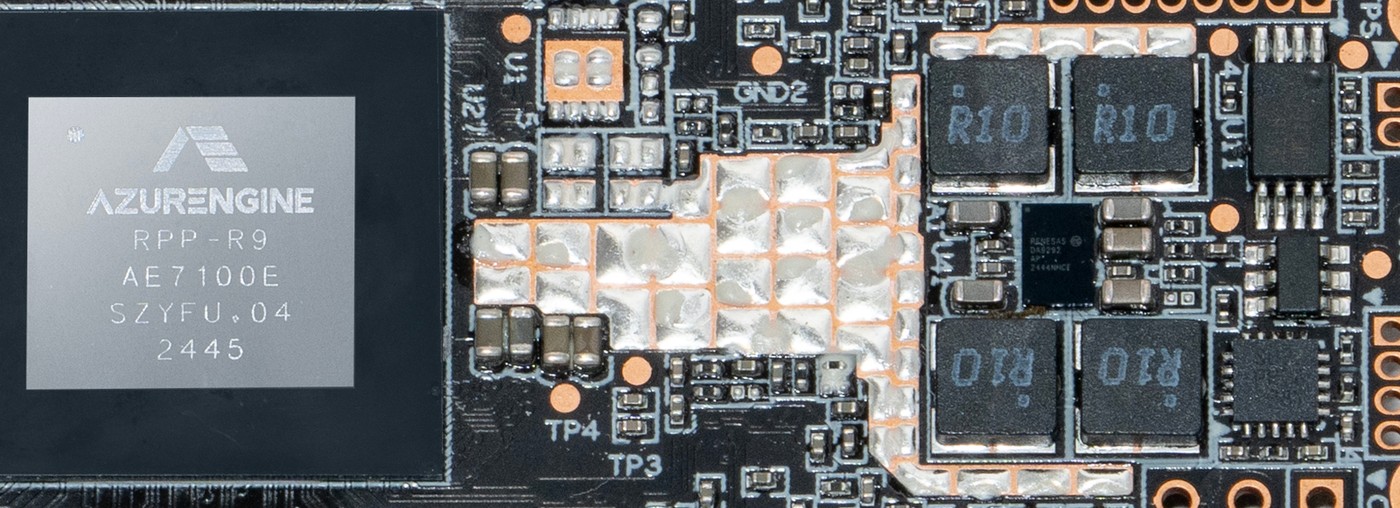
Close-up of the KA08 card showing the RPP-R8 processor package, power delivery components and LPDDR4 memory packages on the PCB
The RPP-R8 package and its power delivery. The card is a standard M.2 module, so it goes into the same slot a storage drive would.
What ships with it

Five services, because a card is not a solution

A box with a model on it is not a deployed system. The gap between the two is filled with quantisation choices, context budgets, concurrency limits and a knowledge base that has to be built from somebody's PDFs. We deliver that part too, on the same hardware.

Digital human

An avatar that greets, answers and gestures — driven locally, on the same box, with the speech and the language model both resident. For lobbies, showrooms and training rooms.

RAG

Your manuals, SOPs and maintenance records, chunked, embedded and retrieved on the device. The answer cites the page it came from, and nothing leaves the plant.

ASR

Offline speech recognition for a noisy floor, so an operator can ask a question with gloves on and no keyboard in sight.

TTS

Local speech output for instructions and alarms. Short, clear, and it keeps working when the network does not.

LLM

Model selection, quantisation, card-count planning and a performance acceptance test on your prompts — not a demo on ours.

Deployment

Imaging, first-line commissioning, the data collection policy for the northbound loop, and handover documentation in Chinese and English.

The part we will not pretend about: a 3B model and a 7B model both run on one card, but only one of them will pass a production acceptance test on a real prompt set at a real concurrency. Choosing between them is engineering, and it is the part of this service that has value.

Enclosure

Extruded aluminium, mounted wherever it fits

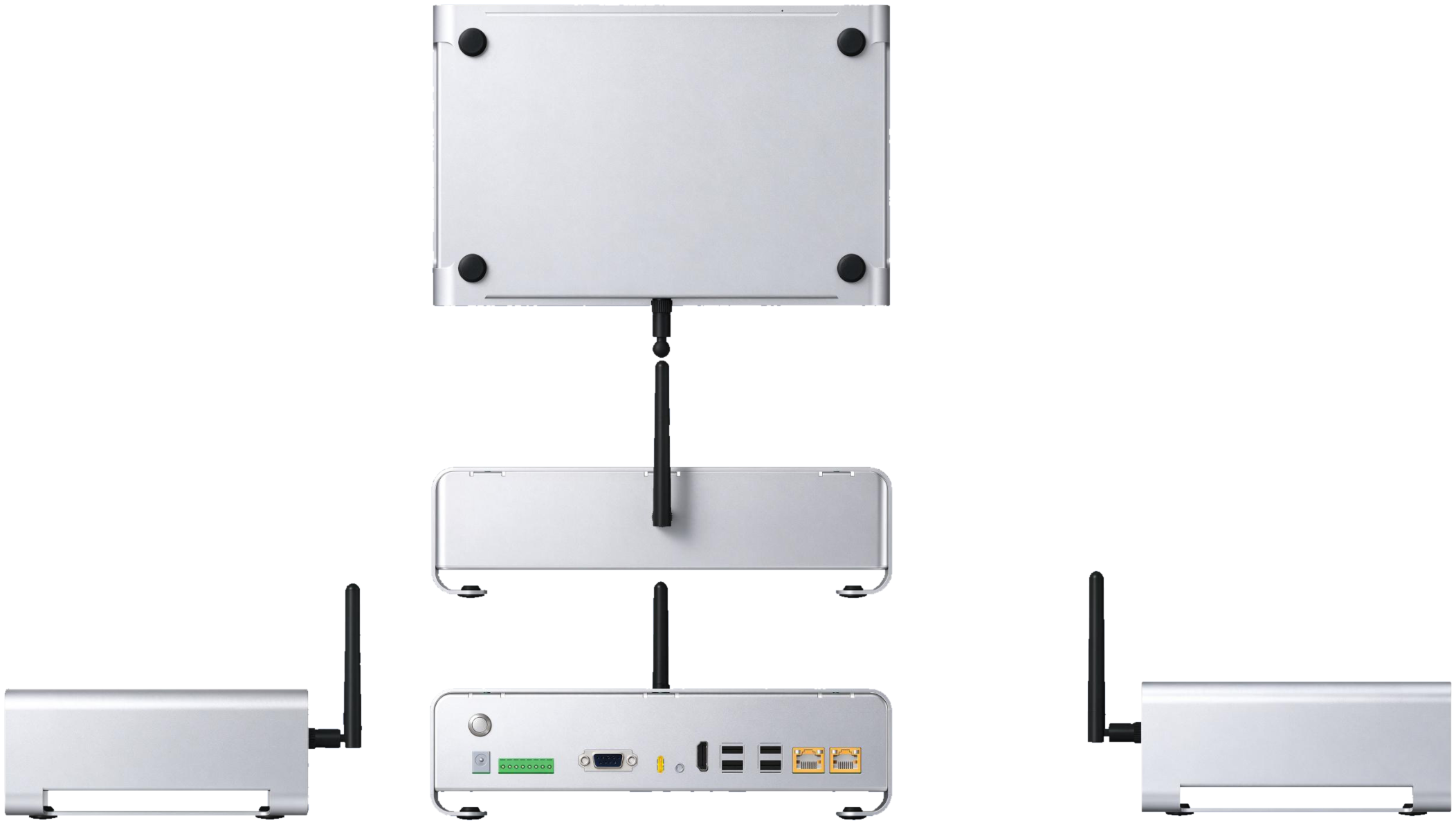
Both hosts share the same shell family: an extruded aluminium body with a brushed finish, mounting feet that double as desk stands and as wall brackets, and a single SMA antenna socket on the top face. Everything that plugs in comes out of one long face, so the box can sit against a panel with only its front accessible.

Six-view engineering drawing of the RK3576 box: top, bottom, front, rear and both side elevations, showing the extruded aluminium chassis, corner screws, mounting feet and SMA antenna
RK3576 build, six views. The drawing shows the corner screws, the mounting feet that double as a desk stand, the single SMA socket on top, and a front face that concentrates power, serial, terminal block, display, USB and Ethernet on one edge.
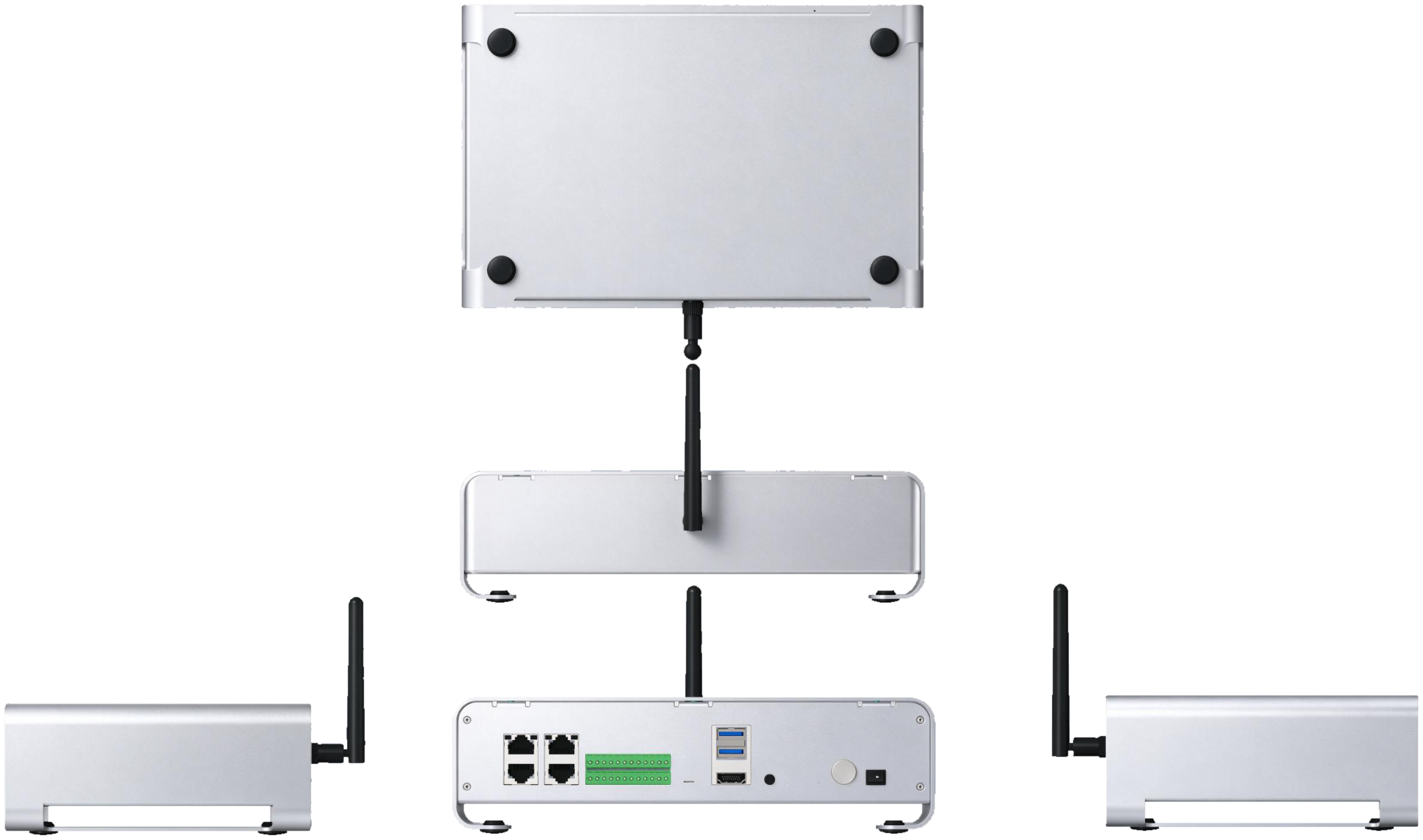
Six-view engineering drawing of the RK3588 box, showing a deeper chassis and a front face with stacked Ethernet ports, a terminal block, USB 3.0 and serial
RK3588 build, six views. The same shell language, a deeper body for the extra cards, and a front face that carries stacked Ethernet, a terminal block, USB 3.0 and serial.

The door, the airflow path and the exact connector population follow the configuration, because a four-card 27B build dissipates roughly twice what a single-card build does and the fan curve has to be specified against the cards that are actually fitted. Mechanical dimensions, ingress rating and port count are fixed per project, not per model name, and we quote them with the configuration rather than publishing a number that only holds for one variant.

Configuration

What you are choosing between

ItemRK3576 buildRK3588 build
Host processorRK3576 — 4× Cortex-A72 + 4× Cortex-A53, up to 2.2 GHz, 6 TOPS INT8 NPU, 8K30 decode, three independent display pipesRK3588 — 4× Cortex-A76 + 4× Cortex-A55, up to 2.4 GHz, 6 TOPS INT8 NPU, 8K60 decode, PCIe 3.0 ×4 with 1×4 / 2×2 / 4×1 bifurcation
Accelerator1 × RK18281 or 4 × RK1828, or KA08 GPGPU
Model class3B — LLM / VLM / sparse MoE3B on one card, 9B on two, 27B on four
Card form factorM.2 Key B-M or SO-DIMMM.2 Key B-M or SO-DIMM
Host linkPCIe 2.0 ×1 or USB 3.0PCIe 2.0 ×1, PCIe switch, or USB 3.0 hub
Card memory5 GB 3D-stacked DRAM on package5 GB per card
Card compute20 TOPS INT8, INT4/8/16, FP8/16, BF1620 TOPS INT8 per card; KA08: 32 TOPS INT8
Host CPU during inference— (not published)2.4–2.6 % of 4×A76 at full load
System power, 2 cards—30.5 W average, 67 W peak
System power, 4 cards—57.8 W average, 119 W peak
Delivered servicesDigital human, RAG, ASR, TTS, LLM, deploymentSame, plus multi-card model sharding
KA08 availability—Pre-order, January delivery, MOQ 10 units
Mechanical & I/OFixed per project configuration — quoted with the order, not published as a single number
FAQ

Questions we get asked first

Can one card run a 7B model, not just 3B?

It can, and vendors in the ecosystem publish single-card 7B and 8B numbers. We quote 3B on one card because that is the capacity that still leaves room for context length and concurrency on a real prompt set. The ceiling and the promise are different numbers, and we would rather be judged on the promise.

Can we buy only the card and put it in our own box?

Yes. RK1828 ships as an M.2 Key B-M module, about 81 x 25 mm, or as a SO-DIMM module, about 69.6 x 45 mm with a higher NPU clock. Both use PCIe 2.1 x1 or USB 3.0. The SO-DIMM version is the one to pick when the enclosure has room and you want the higher NPU frequency.

PCIe or USB 3.0 — does the choice actually matter?

Measured, about 2 to 3 percent on TTFT and prefill, and essentially nothing on decode. Specify PCIe for a latency-critical line. Prototype on USB 3.0, because four cards through one hub is the fastest way to a working system.

RK1828 or KA08 — how do we choose?

By the software you already have. If your models come from PyTorch through the RKNN toolchain, RK1828 is the card and card count sets the model size. If you have a working CUDA and TensorRT pipeline you cannot afford to port, KA08 keeps it running. We will say which one your workload wants, including when the answer is that you do not need this box at all.

Basis of figures

What is measured, what is defined, and what we left out

Measured, from Rockchip's cascade scheme document dated 2026.08: all TTFT, prefill and decode figures, the host CPU and memory overhead, and the system power numbers. Test conditions were an RK3588 host, RK1828 SO-DIMM modules, W4A16 quantisation, 4K or 8K input and 128 output tokens. Power was measured on the whole system including the host, four modules and the card cooling fans — it is not a card-only figure.

Defined by us, not benchmarked: the one-card 3B capacity. Two and four-card capacities follow the vendor's published scheme; the single-card figure is our product position and we are not attaching a benchmark we have not run.

From the card vendor's own published material: the RPP-R8 figures — 32 TOPS INT8, 16 TFLOPS, 1024 ALUs, 24 MB shared memory, 59.7 GB/s, PCIe Gen3 ×4, the 80 × 22 mm module, CUDA and TensorRT compatibility, and the 32-stream 1080p decode capability.

Deliberately not stated: tokens per second for any model on our own hardware — we have not measured it on a production unit, and publishing the vendor's number as ours would be a lie of the most ordinary kind. Card-mounted DRAM capacity for KA08. Mechanical dimensions, weight, ingress rating and port population for both builds, which follow the configuration. Any figure for model accuracy or inspection yield.

Deliberately not used: a third-party case study that was supplied to us marked confidential. Its numbers appear nowhere on this page even where they would have been flattering.
↑