New product · Digital human stage

A 75-inch stage that runs a digital human — and a product display

Two chips, one reason: the media pipeline and the language model are blocked by different things. RK3576 decodes, drives the panel and listens. RK1828 keeps the 5 GB it needs so a 7B model runs there instead of fighting the host for memory bandwidth.

2026-10-30·Product release·Shenzhen
InquireAll news
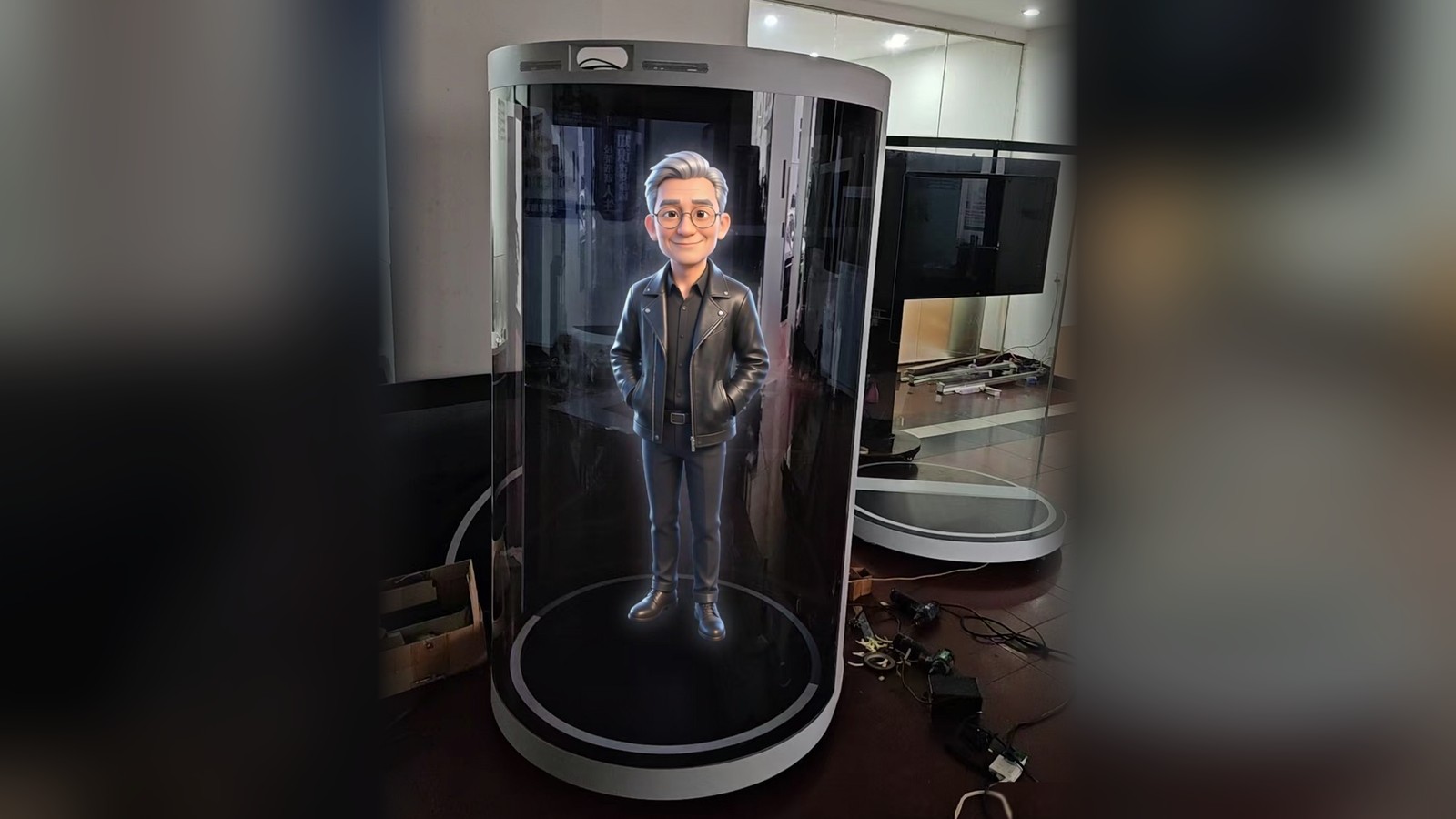
75-inch miniLED hologram stage photographed on site: a cartoon panda character projected inside the half-cylinder glass enclosure
The cabinet is the real machine, photographed on the factory floor before the outer trim went on. The panda inside the glass is AI-generated demo content, standing in for whatever character a customer chooses to run on the 75″ miniLED panel behind the 6 mm half-mirror glass.
Overview

One floor-standing unit, three jobs

Reception, product display, and information — on the same piece of glass.

The enclosure is a half-cylinder: 1050 mm wide, 825 mm deep, 1830 mm tall, flat side to the wall, curve facing the room. Behind the curved skin sits a 75-inch miniLED panel, and between the panel and the visitor sits 6 mm of half-mirror glass. That glass is the whole product: it passes 30 % of the light and reflects 60 %, so the visitor sees the figure and the room in the same plane, and perceives a person standing in air rather than an image on a screen.

What that buys is not one demo but three. A digital human greets, answers and gestures. A 3D product turns slowly on the base ring — the clip below is a car model running in the same enclosure, no digital human involved. And because it is ultimately a very bright, very controllable panel, it does signage and alarm publishing as well. One unit covers a lobby's reception desk, its product wall and its notice screen.

It also runs a model locally. That is the part that needed two chips.

On the word “hologram”. This is not holography in the optical sense — there is no coherent-light interference, no reconstructed wavefront. It is a high-brightness panel viewed through a half-mirror, which is the same trick a theatre uses for a ghost. We call it a hologram stage because that is what the market calls it, and we would rather write the sentence here than have a customer discover it in acceptance testing.

Optics

The glass decides the panel, not the other way round

Lose 70 % of your light at the last surface and the rest of the specification writes itself.

A half-mirror that reflects 60 % and transmits 30 % throws away roughly two thirds of the panel's output before a single photon reaches the viewer's eye. Two consequences follow, and both of them show up in the datasheet as numbers that look like overkill until you know where they came from.

First: 1300 cd/m². Dim the panel and the figure dissolves into the room's reflection — you get a faint ghost behind a mirror. The brightness is not a marketing number, it is the budget left over after the glass.

Second: 320 local-dimming zones. A hologram of a person is mostly nothing — the figure occupies a fraction of the frame and the rest must read as empty air. With a single backlight, that emptiness is grey haze, and grey haze is precisely what kills the illusion. Zones let the surround go genuinely dark while the figure stays at 1300 nits, which is why the 3000:1 physical contrast and the 320 zones matter more here than they would on a signage wall.

1600cd/m² spec ceiling is 1300 on this SKU
320local dimming zones
30%light through the half-mirror
6 mmmirror glass, 60 % reflected

Optics: 75″ miniLED, 3840×2160, 16:9, 3000:1 physical contrast, HDR1000, viewing angle 79° minimum on all four axes, 5 mm acrylic outer skin over sheet-metal with a painted finish. The 79-degree figure is worth noting for placement: a half-mirror is much less forgiving off-axis than a matte panel, so the unit wants a room where people approach it rather than walk past at a glancing angle.

Architecture

Why two chips

Not for the TOPS number. For the memory.

The obvious question is why a stage that already has an eight-core application processor needs a second chip bolted onto it. The answer is that the two workloads are blocked by different resources, and putting them on the same die means they take turns losing.

A media pipeline — decode, composite, drive a 4K panel, run an eight-element microphone array, play 60 W of audio, keep a face detector fed — is compute and IO bound. It wants cores, fixed-function blocks and interfaces, and it wants them deterministic. A language model decode step is memory-bandwidth bound: the arithmetic is small and the weight traffic is enormous, so the tokens-per-second figure follows your bandwidth per byte, not your TOPS per second.

Put both on one SoC and the model competes for the same LPDDR as the 8K decoder and three display pipes. Latency becomes unpredictable exactly when the digital human is mid-sentence, which is the one moment a visitor is watching. Moving inference to RK1828 with its own DRAM removes the argument entirely — the vendor's own framing for the part is that it does not consume the host's memory bandwidth.

ONE STAGE, TWO BOTTLENECKS RK3576 octa-core A72 + A53 · Linux 8K30 H.265 / VP9 / AV1 decode 3 displays: 4K@120 + 2.5K@60 + 2K@60 6 TOPS INT8 NPU (sparse) 16M ISP · 5 × SAI · 2 × COMBO PCIe 2.1 media, display, audio, interaction PCIe 2.0 x1 or USB 3.0 RK1828 M.2 2280 co-processor 20 TOPS INT8 · FP8 / BF16 5 GB 3D-stacked DRAM ~1 TB/s on-package bandwidth 3 × 64-bit RISC-V cores 3B–7B LLM / VLM Hanging off RK3576: 75" miniLED panel 8-mic array 60 W 2.1 audio 5 MP camera Why split: a 7B decode is memory-bandwidth bound, not TOPS bound. On one SoC the model competes with the 8K decoder and three display pipes for the same LPDDR. RK1828 keeps the weights in its own 5 GB and never touches host memory.

The link between them is deliberately modest: PCIe 2.0 x1, about 5 Gbit/s, or USB 3.0. That is enough because the weights do not cross it — they load once and stay resident in the co-processor's own memory. What crosses the link is a prompt and a stream of tokens, which is a trickle compared with a model file.

Media side

RK3576: what the other half is doing

RK3576 is an eight-core part: four Cortex-A72 and four Cortex-A53 up to 2.2 GHz, 1 MB of unified L2 behind the A72 cluster and 512 KB behind the A53s, plus a Cortex-M0 for housekeeping, an ARM Mali-G52 MC3 GPU with Vulkan 1.2, and a 6 TOPS INT8 NPU. Every one of those has a job here.

The decoder handles 8K30 H.265, VP9, AV1 and AVS2, with 4K@120 on H.265 and 4K@60 H.264 — a 4K panel driven at 60 Hz leaves a great deal of headroom for a second and third stream, which is what an information-display mode needs. Display output supports three independent pipes (4K@120 + 2.5K@60 + 2K@60); this unit's front panel uses one of them, and the others exist for the variant with an operator screen or a ceiling banner.

Audio is where the part earns its place in this product. It exposes five SAI interfaces, seven transmit and seven receive lanes, each lane carrying eight channels of I2S/PCM/TDM, plus two 8-channel PCM ports, two S/PDIF transmitters, one receiver and ASRC. Eight microphones and a 2.1 amplifier are not an afterthought on this pin budget — they are a fraction of it. The 16 M-pixel ISP with HDR and 3DNR feeds the 5-megapixel camera, and the image signal is what lets the unit notice a visitor rather than wait to be touched.

Two combo USB 3.0 / PCIe 2.1 / SATA3 ports are what the co-processor plugs into, and having two of them is why a two-card build is a configuration rather than a redesign.

Inference side

RK1828: the memory is the feature

RK1828 is an M.2 2280 Key-M co-processor, not a system on chip. It carries 20 TOPS INT8 with INT4, INT8, INT16, FP8, FP16 and BF16 support, three 64-bit RISC-V cores, and — the number that actually decides what fits — 5 GB of 3D-stacked DRAM on the package, with a theoretical bandwidth around 1 TB/s. Its smaller sibling, RK1820, carries 2.5 GB and is aimed at 3B-class models; the 1828 is the one that holds a 7B model resident.

That resident fit is the point. If the weights do not fit, every token costs a stream of weight traffic across PCIe, and the interconnect becomes the ceiling no matter how fast the NPU is. Keeping them on-package changes the failure mode from “thermally and bandwidth throttled after a few sentences” to “steady state”.

20TOPS INT8, INT4/8/16 · FP8/16 · BF16
5 GB3D-stacked DRAM on package
~1 TB/stheoretical on-package bandwidth
3B–7Bmodel class held resident

It has a second life too. With three RISC-V cores of its own it can run a lightweight Linux image and stand alone as an offline AI module, which is what the variant SKU uses when a customer wants the stage to keep answering with the network down.

What we will not put in a datasheet. Module vendors publish figures for this class of part such as “a 7B model at 59–180 tokens per second”. Those numbers come from a particular model, a particular quantisation and a particular prompt length, and they move by a factor of two between them. We will quote you a tokens-per-second figure measured on your model on our bench, and not before.

The same caution applies to power. Sources disagree on this part's typical draw, so we have not printed one.

In motion

The same enclosure, showing a product instead of a person

Filmed on site, twelve seconds, unedited.

12 s, on-site capture.

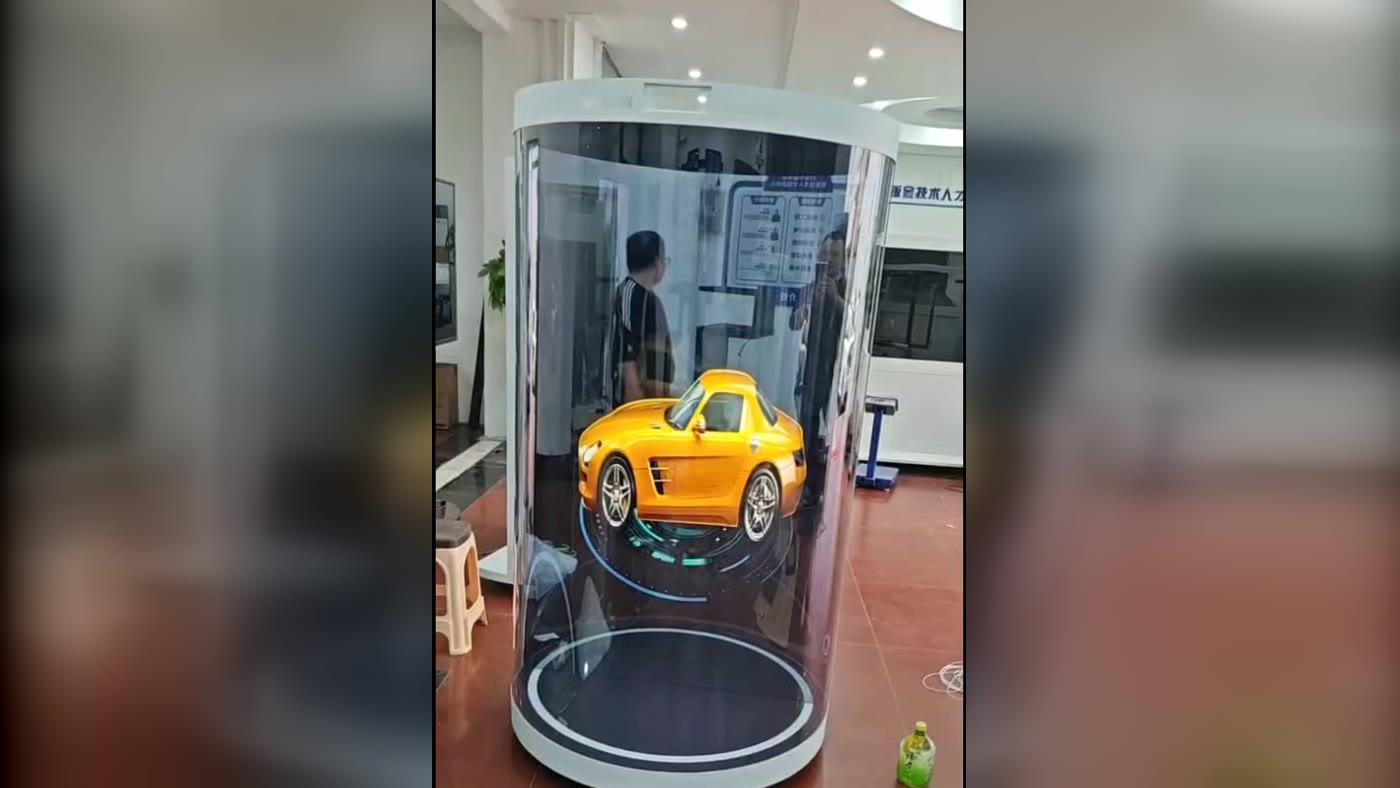
A 3D car model turning on the base ring. No digital human, no change of hardware — this is the same unit running a different scene file, which is the argument for putting a very bright miniLED panel behind that glass in the first place: the panel does not care whether the content is a person or a product.

For retail and showroom work this is the practical mode. A car, a machine tool, a bottle, an assembly, a building — anything with a model turns on the ring and can be walked around, at a size a phone screen cannot deliver and at a brightness a projector cannot reach in a lit room.

It is also the honest way to show what “holographic” means here. Watch the reflection of the room in the glass: it is still there, moving over the image. That is a half-mirror doing its job, and it is the reason the figure has volume.

A 3D car model rendered inside the hologram stage, rotating above the lit base ring
Frame from the clip above. The cyan ring under the model is the base-ring light effect; the blue glow on the plinth is the enclosure's own illumination.
Mechanical

A half-cylinder, because a lobby has a wall

1050 × 825 × 1830 mm, and why the panel is mounted upright.

Studio render of the hologram stage, front and rear: the front view shows a female digital human standing on a lit base ring behind curved glass, the rear view shows the connector bay with ports, antenna and power switch
Design render. Front: the figure stands on the lit base ring inside the curved glass. Rear: connector bay, antenna and power switch low on the panel, where a technician can reach them.
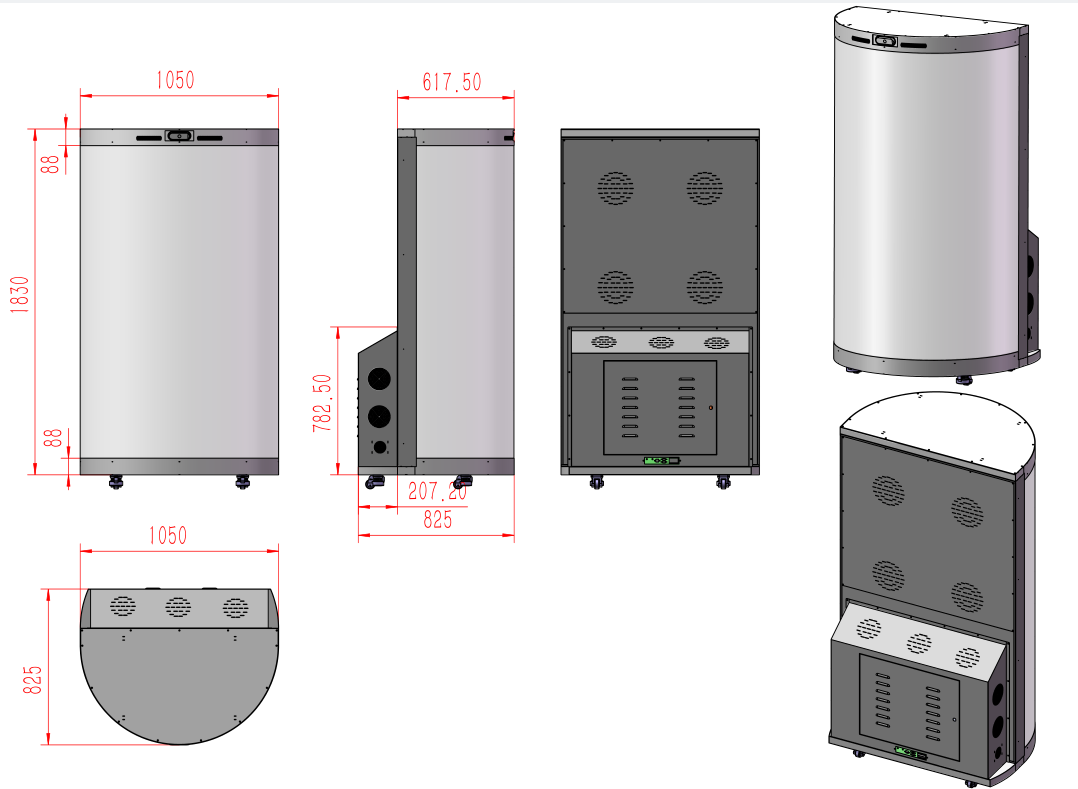
Dimensional drawing of the hologram stage: front, side, rear, top views and two isometric views, with 1050 mm width, 825 mm depth and 1830 mm height
Outline drawing from the specification: 1050 mm wide, 825 mm deep, 1830 mm tall, 88 mm trim rings top and bottom. Rear panel carries four fans, a vent stack and the connector bay.

A full cylinder wastes the half of the volume nobody stands in and forces the unit out into the room. The D-shaped section puts the flat face against a wall or a column and brings the curve forward, so the footprint a lobby actually loses is 0.87 m² rather than a circle you have to walk around.

The panel is mounted upright, and the numbers are why. The glass is specified at 1649 × 927 mm. Turned portrait that is 927 mm across and 1649 mm tall; the body is 1050 mm wide, which leaves 61.5 mm of side border, and 1830 mm tall against a 1649 mm image, which leaves 90.5 mm — matching the 88 mm trim rings called out on the drawing. A 16:9 panel in landscape would be 927 mm tall, shorter than a seated visitor's eye line in a 1.8 m cabinet, and a standing full-body figure would be cut at the knee.

The engineering conclusion: a digital human is a portrait problem. Every parameter that gets argued about — panel size, mounting orientation, camera height, the position of the lit base ring — is downstream of the fact that a standing person is tall and narrow. The alternative, a wall-mounted landscape screen, is a video wall with a person drawn on it, which is not the product.

Specification

As specified

From the V1.0 specification and the outline drawing. No bench measurements are claimed anywhere on this page.

ItemValue
Panel75″ miniLED, 16:9, 3840 × 2160
Display area1649 × 927 mm (mounted portrait: 927 wide × 1649 tall)
Brightness1300 cd/m²
Local dimming320 zones
Contrast / HDR3000:1 physical · HDR1000
Viewing angleR/L 79° min, U/D 79° min
Half-mirror glass6 mm, 30 % transmission, 60 % reflection
EnclosureSheet metal, painted finish, 5 mm acrylic outer skin
Dimensions1050 (W) × 825 (D) × 1830 (H) mm, 88 mm trim rings
Audio60 W, 2.1 channels
Microphones8-element array
Camera5 MP, driver-free
ComputeRK3576 (4×A72 + 4×A53 @2.2 GHz, Mali-G52 MC3, 6 TOPS NPU) + RK1828 (20 TOPS, 5 GB on-package DRAM)
PowerAC 100–240 V, 50/60 Hz, 1100 W rated
Operating0–40 °C, 10–85 %RH non-condensing
Storage−10–60 °C, 10–90 %RH non-condensing
I/OHDMI, VGA, USB, network
FAQ

Questions we get asked first

Is this a real hologram?

No. There is no coherent-light interference and no reconstructed wavefront. It is a 1300 cd/m2 miniLED panel seen through a 6 mm half-mirror that reflects 60 % and transmits 30 %, which is the same technique a theatre uses to make a ghost appear on stage. The effect reads as a figure standing in air because the surrounding area is dimmed to near-black by 320 local-dimming zones while the figure stays bright.

How large a model runs on the device?

RK1828 carries 5 GB of on-package DRAM and is positioned at 3B to 7B class models held resident. The 2.5 GB RK1820 covers 3B class. Two cards can be fitted because RK3576 exposes two combo PCIe 2.1 ports, and cascade configurations extend the ceiling further, but we will not quote a size until the model, the quantisation and the prompt length are fixed.

Why not a single SoC? Does it not already have a 6 TOPS NPU?

It does, and that NPU is busy: face and pose detection, wake word, voice activity, avatar rendering support. The 6 TOPS figure is also a sparse INT8 peak, and a language model decode step is limited by memory bandwidth rather than by peak arithmetic. On one die the model, the 8K decoder and three display pipes share the same LPDDR. Two chips means two independent memory budgets, and the one that must be predictable - the spoken reply - cannot be starved by the one that only has to look good.

Can we buy only the electronics?

Yes. The dual-chip board set with firmware, model runtime and display pipeline is one of the three delivery levels, and it is the usual choice for a customer with their own cabinetry or an integrator working into an existing fit-out.

Delivery

What you can actually buy

Three levels, because not every customer wants a cabinet.

1. Finished stage

The unit as drawn here, with your digital human, your content and your backend. Includes the acoustic and optical alignment done on the real cabinet, not on a bench.

2. Dual-chip core

The RK3576 + RK1828 board set with the firmware, the model runtime and the display pipeline, for a customer who already builds their own enclosure.

3. Digital human and backend

Avatar, voice, ASR/TTS, the retrieval behind the answers, device management, content publishing and OTA. On your cloud or ours — the firmware changes one module.

Not included by default

We do not supply a licensed likeness, and we do not supply a model checkpoint we did not train. If you bring a model, we will benchmark it on the bench before either of us quotes a token rate.

—

Basis of figures

Panel, optics and mechanical figures [customer specification]: “75″ miniLED Digital Human Hologram Stage Technical Specification V1.0”, December 2024 — 75″ miniLED, display area 1649 × 927 mm, 16:9, 3840 × 2160, 1300 cd/m², 320 zones, 3000:1 physical contrast, R/L and U/D 79° minimum, HDR1000, 6 mm mirror glass at 30 % transmission and 60 % reflection, sheet metal with painted finish and 5 mm acrylic skin, 60 W 2.1 audio, 8-element microphone array, 5 MP driver-free camera, AC 100–240 V, 1100 W rated, 0–40 °C operating. Overall dimensions 1050 × 825 × 1830 mm and the 88 mm trim rings are read from the outline drawing supplied with that document. The portrait mounting and the 61.5 mm / 90.5 mm borders are arithmetic on those two sources, not a separate published claim, and the drawing corroborates them to within 2.5 mm. RK3576 [chip]: Rockchip RK3576 product page and RK3576 Brief Datasheet — quad Cortex-A72 plus quad Cortex-A53 to 2.2 GHz, 1 MB unified L2 for A72 and 512 KB for A53, Cortex-M0, Mali-G52 MC3 with Vulkan 1.2, 6 TOPS INT8 with int4/int8/int16/FP16/BF16/TF32, 32-bit LPDDR4/4x/LPDDR5, 8K30 H.265/VP9/AV1/AVS2 decode, 4K@120 H.265, 4K@60 H.264, 4K@60 encode, 16 M ISP with HDR and 3DNR, three MIPI CSI-2 inputs, multiple displays to 4K@120 + 2.5K@60 + 2K@60, five SAI interfaces at seven transmit and seven receive lanes with eight channels per lane, two 8-channel PCM, two S/PDIF TX and one RX, ASRC, combo USB 3.0 / PCIe 2.1 / SATA3. RK1828 [chip]: Rockchip “RK182X series” co-processor description plus module-vendor specification pages — M.2 2280 Key-M, PCIe 2.0 x1 or USB 3.0 link, 20 TOPS INT8 with INT4/INT8/INT16/FP8/FP16/BF16, 5 GB 3D-stacked DRAM at a theoretical 1 TB/s, three 64-bit RISC-V cores, resident 3B–7B class models, RK1820 variant at 2.5 GB for 3B-class. Deliberately not stated: the specification's line that power is “only 30 % of an equivalent LCD”, which cannot be reconciled with its own 1100 W rating, and any typical-power figure for RK1828, on which published sources disagree. No tokens-per-second figure is quoted for any model, because none has been measured on this unit. Nothing on this page is a bench measurement of acoustic or optical performance.

Next step. Tell us the room, the sight line, and whether the content is a person, a product, or both. We will tell you which of the three delivery levels fits and where the money goes. → Contact us
↑